What Is the Difference Between A Rising Stem Gate Valve and A Non-rising Stem Gate Valve?
A gate valve is an opening and closing component that moves perpendicular to the fluid direction. It can only be fully opened and fully closed, and cannot be adjusted or throttled.
Rising stem valves
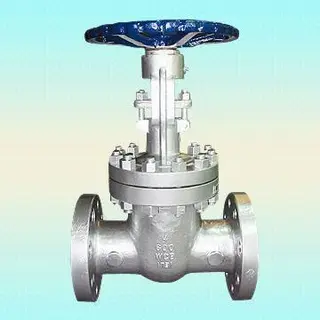
The structure of rising stem gate valves: The valve stem nut is on the valve cover or bracket, and the handwheel is rotated to lift or lower the valve plate connected to the valve stem through the thread of the handwheel and valve stem, achieving the function of opening and closing.
The advantages of a rising stem gate valve are: low fluid resistance, and the sealing surface is less susceptible to erosion and erosion by the medium. Opening and closing is more effortless. The flow direction of the medium is unrestricted, without disturbance or pressure reduction. It has simple form, short structural length, good manufacturing processability, and wide applicability.
The disadvantage of a rising stem gate valve is that it is prone to erosion and abrasion between the sealing surfaces, making maintenance difficult. The external dimensions are large, requiring a certain amount of space for opening and a long opening and closing time. The structure is relatively complex.
Non-rising stem valves
The non-rising stem gate valve is also known as a rotary stem gate valve (also known as non-rising stem wedge gate valve). The valve stem nut is installed on the gate plate, and the handwheel rotates to drive the valve stem to rotate, thereby lifting the gate plate. Usually, there are trapezoidal threads at the bottom of the valve stem. Through the threads at the bottom of the valve and the guide groove on the valve disc, the rotational motion is converted into linear motion, that is, the operating torque is converted into operating thrust.
When the valve is opened and when the lifting height of the gate is equal to 1:1 times the valve diameter, the fluid channel is completely unobstructed, but this position cannot be monitored during operation. In actual use, the vertex of the valve stem is used as a marker, that is, the position where it cannot be opened, as its fully open position. To consider the phenomenon of locking due to temperature changes, it is usually done by opening the valve to the top position and then reversing it by 1/2 to 1 turn as the position for fully opening the valve. Therefore, the fully open position of the valve is determined by the position of the gate (i.e. stroke).
The advantage of this structure is that the height of the gate valve remains constant, so the installation space is small, making it suitable for gate valves with large diameters or limited installation space. This structure should be equipped with an opening and closing indicator to indicate the degree of opening and closing.
The disadvantage of this structure is that the valve stem thread not only cannot be lubricated, but also directly accepts the erosion of the medium, which is easy to damage.
Rising stem vs. non-rising stem
1. Rising stem gate valves can see the lead screw, while non-rising stem valves cannot see the lead screw.
2. Rising stem gate valves are operated by threading the valve stem and steering wheel to lift or lower the valve disc. When the non-rising stem gate valve is opened and closed, the steering wheel and valve stem are connected together and relatively stationary. It is driven by the rotation of the valve fixed point to lift and lower the valve disc to complete the opening and closing.
3. The transmission thread of the non-rising stem gate valve is located inside the valve body. During the opening and closing process, the valve stem only rotates, and the gate plate rises and falls inside the valve body. The valve stem of a rising stem gate valve drives the gate to rise and fall together. The transmission thread of the valve stem is located outside the valve body, and the opening and closing and position of the gate can be intuitively determined based on the direction and position of the valve stem movement.
4. The height dimension of the non-rising stem gate valve is relatively small. Rising stem gate valves require a large installation space.
5. The structure of a rising stem gate valve is beneficial for the lubrication of the valve stem and has a significant degree of opening and closing. The thread of the valve stem of a non-rising stem gate valve is not only unable to be lubricated, but also directly susceptible to medium erosion, making it easy to damage. Therefore, rising stem valves are more widely used.