Basic Knowledge of Floating Ball Valves And Fixed Ball Valves
A ball valve is a valve that uses a ball as its opening and closing component. With the rapid advancement of processing technology, detection technology, and intelligent control technology, as well as the continuous emergence of various new sealing materials, the products of ball valves will be increasingly widely used. At present, the products of ball valves are not only applied in general industrial pipelines, but also widely used in West East Gas Pipeline, coal to oil engineering, nuclear industry, and aerospace industry transportation pipelines.
As early as the 1880s, the United States began designing ball valves, but the lack of appropriate sealing ring materials at that time limited the development of ball valve products. It was not until the 1950s that the emergence of elastic sealing materials such as polytetrafluoroethylene and the development of the machine tool industry led to a turning point and rapid development of ball valve products.
1. The structure and terminology of a ball valve mainly consist of a valve body, a valve seat, a ball, a valve stem, and a handle (or other driving device). The main function of a ball valve is to cut off or connect the fluid channel in the pipeline. Its working principle is simple: by using a handle or other driving device to apply a certain torque on the upper end of the valve stem and transmit it to the ball, rotate it by 90 ℃, so that the channel of the ball coincides or is perpendicular to the centerline of the valve body channel, completing the full open or full close of the ball valve.
The structural types and specifications of ball valves are extremely diverse, and new products and structures are still emerging. According to the characteristics and uses of ball valves, they can be divided into several types.
According to the support method of the sphere, it can be classified into floating ball valves and fixed ball valves.
Floating ball valves: Its main feature is that the ball has no supporting shaft, and the ball system is supported by the valve seats at both ends of the valve inlet and outlet. The valve stem is connected to the ball in a movable manner. The ball of this ball valve is held in a "floating state" by two valve seats. The sphere can freely rotate between the two valve seats through the valve stem with the help of a handle or other driving device.
When the flow channel hole of the sphere is aligned with the valve channel hole, the ball valve is in an open state, the fluid is unobstructed, and the fluid resistance of the valve is minimized. When the ball is rotated 90 ℃, the flow channel hole of the ball is perpendicular to the valve channel hole, and the ball valve is in a closed state. Under the action of fluid pressure, the ball is pushed towards the valve outlet end (referred to as the valve back) seat, which is compressed and ensures sealing.
The main advantages of floating ball valves are simple structure, easy manufacturing, low cost, and reliable operation. The sealing performance of floating ball valves is related to fluid pressure. Under the same conditions, generally speaking, the higher the pressure, the easier it is to seal. However, consideration should be given to whether the valve seat material can withstand the load transmitted to it by the sphere, as the force generated by fluid pressure on the sphere will be fully transmitted to the valve seat behind the valve.
In addition, for larger floating ball valves, when the pressure is high, the operating torque increases, and the self-weight of the ball is also large. The pressure distribution generated by the self-weight on the sealing surface of the valve seat is uneven. Generally speaking, the pressure in the upper half of the horizontal plane along the channel diameter is smaller, and the pressure in the lower half is larger, resulting in uneven wear of the valve seat and leakage. Therefore, floating ball valves are generally suitable for valves ≤ PN10 and ≤ DN200.
In order to ensure good sealing performance of the floating ball valve at lower working pressures, a certain preload force must be applied between the ball and the valve seat. Insufficient pre tightening force cannot guarantee sealing, while excessive pre tightening force can increase friction torque and may also cause plastic deformation of the valve seat material, thereby damaging the sealing performance.
For low-pressure ball valves, the preload can be limited by adjusting the thickness of the sealing gasket between the flanges. To ensure the sealing and reliability of the floating ball valve during operation, attention should be paid to the following during design.
a. The contact surface between the ball and the valve seat should have sufficient sealing pressure, but the sealing conditions must be met.
b. The sealing pressure ratio between the valve seat and the bottom surface of the valve body groove should be equivalent to the sealing pressure ratio on the contact surface of the sphere. If the sealing pressure is insufficient, the outer diameter of the valve seat bottom surface can be reduced or the inner diameter can be increased. Several concentric triangular grooves with a top angle of 60° and a depth of 1 to 2mm can also be opened on the bottom surface.
c. The sphere should have the correct geometric shape and appropriate surface roughness.
d. The currently ideal method for applying pretension force through the rational selection of sealing materials is to use ball valves with elastic valve seats. The elastic valve seat can greatly increase the elastic deformation range of the valve seat itself, enabling it to maintain good sealing performance under low or high pressure. As long as it operates within the elastic deformation range of the elastic valve seat, its sealing pressure can be basically maintained constant, so that the valve seat will not be damaged due to overload.
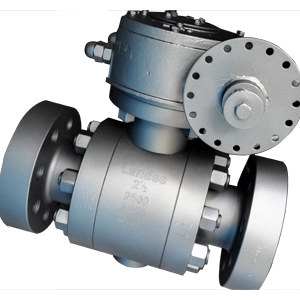
2. Fixed ball valves: the ball is connected to the upper and lower valve stems as a whole, or made into an integral shaft ball, that is, the ball is forged (welded) with the upper and lower valve stems and installed on the bearing. The ball can freely rotate along the axis perpendicular to the valve channel, but cannot move along the channel axis. Therefore, when the fixed ball valve is in operation, all the force generated by the fluid pressure in front of the valve on the ball is transmitted to the bearing, and the ball will not move towards the valve seat behind the valve, so the valve seat will not bear excessive pressure. Therefore, the torque of the fixed ball valve is small, the deformation of the valve seat is small, the sealing performance is stable, and the service life is long. It is suitable for high-pressure and large-diameter applications.
The key to sealing a fixed ball valve lies in correctly selecting the structure of the elastic sealing valve seat, designing the dimensions of each part of the valve seat reasonably, and cleverly utilizing fluid pressure or spring force to achieve sealing requirements.