In modern chemical, energy, pharmaceutical and other industrial fields, precise control of fluids is as crucial as the circulation of blood in the human body. Pneumatic ball valves have become an indispensable key equipment in industrial automation pipelines due to their unique structural design, reliable operating performance, and high degree of automation compatibility.
1. How does a pneumatic ball valve work?
The working principle of pneumatic ball valve can be vividly understood as "pneumatic drive, ball core rotation, achieving on/off".
1. Valve body: key "rotating ball"
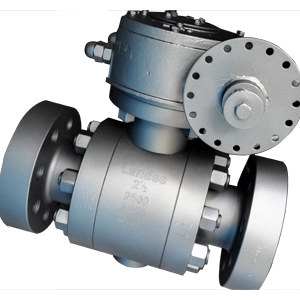
The key to a valve is a precision ball (core) with a through-hole in the middle. When the axis of the through-hole is aligned with the axis of the pipeline, the medium can pass smoothly and the valve is in the open state. When the driving device drives the sphere to rotate 90 degrees, making the through-hole perpendicular to the pipeline, the solid part of the sphere itself will completely block the flow path, and the valve will be in a closed state. This "full bore" or "reduced bore" design minimizes pressure loss when the ball valve is opened and tightly seals when closed.
2. Source of power: pneumatic actuators
This is the "muscle" and "brain" of valve automation. Its working principle is based on pneumatic transmission.
Air supply: compressed air (usually 0.4-0.7MPa) is purified and stabilized through a filtering pressure reducing valve before being input into the actuator.
Core action: For the most common double acting actuator, compressed air enters from one end of the air inlet, pushing the internal piston or rack to move. The linear motion is converted into a 90 degree rotational output through gears or screws, thereby driving the ball core to rotate. The gas at the other end is expelled. When reverse action is required, the air path is switched through an electromagnetic valve, and compressed air enters from the other end to achieve reverse driving.
Key attachment: The solenoid valve serves as a switch for the electronic control air circuit, receiving electrical signals from the control system and determining the direction of airflow. The locator precisely adjusts the intake volume, controls the valve opening, and achieves proportional adjustment (for adjustable ball valves). Limit switches are used to provide feedback on the switch position status of valves.
3. Work cycle: from signal to action
The entire workflow forms an efficient automated closed loop.
Control signal (electric) → solenoid valve action (electric pneumatic conversion) → compressed air driven actuator (pneumatic conversion) → ball rotation 90 ° → valve opening/closing/adjustment → position signal feedback This process can be completed instantly with extremely fast response speed, meeting the real-time requirements of modern industry for process control.
2. Advantages of choosing pneumatic ball valves
Compared to manual, electric, or hydraulic valves, pneumatic ball valves demonstrate outstanding advantages in multiple aspects.
Quick action and response: the compressibility of the gas allows the actuator to move at high speed, usually only requiring a few seconds for a single opening and closing, making it suitable for situations that require quick shut-off.
High safety: essentially explosion-proof, with no risk of electric sparks, especially suitable for flammable and explosive environments such as petroleum and chemical industries. In the event of a gas failure, a spring can be installed to achieve a fault safe type (fault on or fault off).
Simple structure, and easy maintenance: few actuator components, high reliability, and low daily maintenance workload.
Large output torque: compared with electric vehicles, it can generate greater torque at the same volume, which is suitable for high pressure differentials and large-diameter pipelines.
Strong environmental adaptability: the selection range of high-temperature and corrosion-resistant materials is wide, which can meet harsh working conditions.
3. Pneumatic ball valves are widely used.
With its outstanding performance, pneumatic ball valves are active in various industrial fields.
Petrochemical and natural gas: it is used in oil and gas pipelines and refining facilities for emergency cut-off, isolation, and distribution of crude oil, refined oil, natural gas, and various chemical media. Its explosion-proof characteristics are irreplaceable in this field.
Energy and electricity: it's used for controlling boiler systems, cooling water systems, and steam pipelines in power plants, achieving reliable regulation and shutdown of fuel, water, and steam.
Pharmaceutical and food industries: it is made of stainless steel material and polished to a sanitary grade to meet sterile requirements, with precise control of process fluids and CIP/SIP cleaning processes to ensure product safety.
Water treatment and environmental protection: in municipal water supply and sewage treatment plants, the control of water flow and the addition of chemicals are highly automated and corrosion-resistant.
Automated production line: as a pneumatic control component for robotic arms and assembly lines, it realizes the on/off of auxiliary media such as compressed air and coolant.
Special working conditions: such as high-temperature steam pipelines, low-temperature liquefied gas (LNG) pipelines, and slurry pipelines with particles, all have specially designed pneumatic ball valves to take on important responsibilities.
Conclusion
From basic principles to cutting-edge applications, pneumatic ball valves perfectly embody the exquisite combination of mechanical design and pneumatic automation. It is not only a simple mechanical component in pipelines, but also the cornerstone of automation that ensures the safe, efficient, and precise operation of modern industrial processes. With the continuous advancement of materials science and control technology, this' precise switch operator 'will undoubtedly perform a more accurate and reliable fluid control movement on a broader industrial stage.